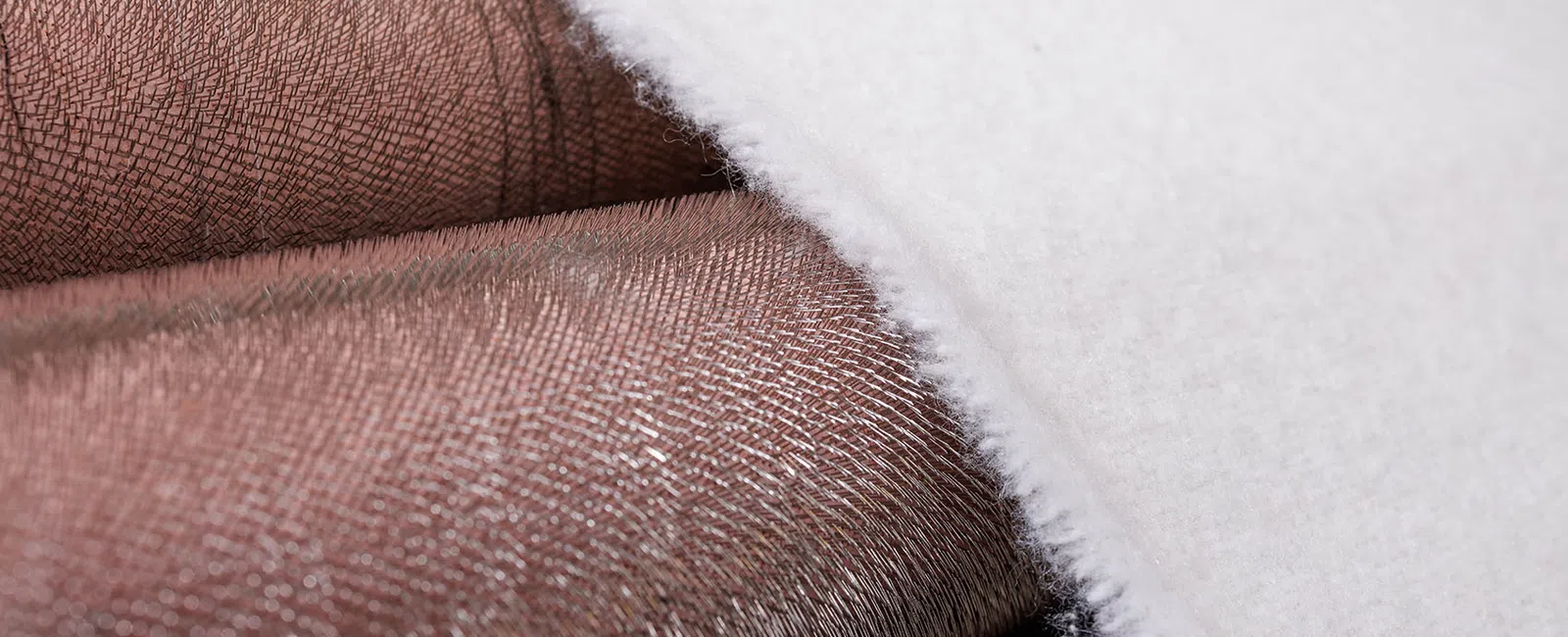
Summary: Liquid filtration and gas filtration place fundamentally different demands on filter fabric. Liquid separation drives fabric selection around chemical resistance, pressure tolerance, and cake release. Gas filtration drives fabric selection around thermal stability, air permeability, and pulse cleaning survival. Custom filter media that works for one rarely works for the other without construction changes.
Key Takeaways:
- The engineered fabric that solves for liquid filtration rarely solves for gas filtration, and vice versa.
- Liquid filter media is engineered for chemical resistance, hydrophobic behavior, cake release under mechanical pressure, and structural stability against hydraulic load.
- Gas filter media is engineered for thermal stability, air permeability at high flow, dust cake release under pulse cleaning, and dimensional stability against dynamic mechanical shock.
A polyester woven filter cloth in a pharmaceutical process line and a polyester woven filter cloth in a hot gas application are the same yarn, run on the same loom, at similar weights. Neither one performs in the other's environment.
The reason is that liquid filtration and gas filtration are different engineering problems with different failure modes. The fiber is often the same. The construction that carries the fiber is different.
The Differences in Liquid and Gas Filtration
Four variables that affect filtration fabric:
- Flow direction and pressure profile: Liquid filtration applies static pressure through the media, pushing liquid through and holding solids on the surface. Gas filtration pulls gas through the media at high velocity, with cake forming on the upstream face and cleaning happening in the reverse direction.
- Temperature range: Liquid filtration usually operates from ambient to 250°F (121°C). Gas filtration commonly operates from 200°F to 500°F (93°C to 260°C), with some industrial baghouses running higher.
- Particulate profile: Liquid streams carry wet, often variable-size solids. Gas streams carry fine, dry, often abrasive particulates.
- Cleaning mechanism: Liquid filters release cake through mechanical scraping, back-wash, or plate opening. Gas filters release cake through pulse air, reverse gas flow, or mechanical shaking.
These four differences change every downstream fabric decision.
What Does Liquid Filtration Demand from Filter Fabric?
Liquid filtration media has to avoid multiple points of weakness during the filtration process.
Cake blinding, fiber breakdown, elongation, and poor cake release. Cake blinding causes pressure drop to climb across a cycle that used to run clean. Fiber breakdown occurs when the fabric goes brittle in the wash down cycle. Elongation is visible sagging between the plates. Poor cake release shows up as cake sticking to the media at discharge, forcing manual scraping between cycles.
Each failure mode traces back to a construction decision made before the cloth ever reached the press:
- Cake blinding traces to a weave that traps fines in the interstices, or a monofilament yarn chosen for smooth cake release at the cost of tight surface capture.
- Fiber breakdown traces to a chemistry the fiber was not rated for. Polyester breaks down in caustic chemistry. Polypropylene breaks down above 220°F (104°C). Nylon is compromised in extended chemical wash-down.
- Elongation traces to a weight-to-hydraulic-load mismatch. The fabric weight was under-specified for the pressure the press applies.
- Poor cake release traces to yarn geometry on the upstream face. Spun staple grips cake; monofilament releases it.
The specification decisions that avoid these failures include:
- Fiber selection (polyester, polypropylene, polytetrafluoroethylene (PTFE), nylon)
- Yarn type (monofilament, multifilament, spun staple)
- Weight per square yard tuned to the hydraulic load
- Micron rating is tuned to the particle size distribution, typically 1 to 500 microns depending on the process stream.
Our team at SIF has extensive experience in mitigating the demands of liquid filtration. As one example, we have worked with multiple clients over 30 years in the metal plating and finishing industry. Many of those clients electroplate metal parts for a variety of uses. Electroplating depends on controlled bath chemistry and clean solution. As soluble anodes or metal-filled baskets operate, fines, residues and other insoluble material can be released. If those particles enter the bath, they can increase the filtration burden and contribute to roughness, pitting, cleanup and rework.
Our custom engineered anode bags provide filtration at the source. Fitted around an anode or basket, the fabric allows the electrolyte to circulate while retaining particulate matter near the anode. The fabric balances particle retention with flow, chemical compatibility and wet durability.
What Does Gas Filtration Demand from Filter Fabric?
Gas filtration media has to hold four properties at once: it has to stay dimensionally stable at operating temperature, it has to pass gas at the flow rate the fan is sized for, it has to shed dust cake when the pulse fires, and it has to survive that pulse cycle thousands of times without the felt structure breaking down.
The specification decisions for gas filtration include:
- Fiber selection: Polyester works below 275°F (135°C). Aramid (Nomex, DuPont) handles up to 400°F (204°C). P84 polyimide (Evonik) handles up to 500°F (260°C). Fiberglass and PTFE handle 500°F (260°C) and above, with PTFE adding premium chemical resistance at the top of the range.
- Construction: Gas filtration often favors needle-punched nonwoven felt reinforced with a woven scrim. The felt provides depth filtration and dust cake surface; the scrim provides structural stability. For high-temperature applications where woven construction is required, aramid, fiberglass, and PTFE woven fabrics are used.
- Air permeability: This specification balances capture efficiency against pressure drop and energy cost.
- Membrane laminates: Expanded polytetrafluoroethylene, or ePTFE, membrane bonded to the substrate provides sub-micron capture and surface filtration for high-efficiency applications.
- Cake release under pulse cleaning: This is the priority mechanical property. Pulse jet air fires compressed air into the filter bag interior, momentarily reversing flow and knocking cake off the upstream surface.
Common failure modes in gas filtration trace back to specific construction decisions:
- Thermal degradation traces to fiber temperature limits exceeded during upset conditions, not steady-state operation. Sizing to steady-state without headroom is the specification error.
- Pulse fatigue traces to needle-punched structure breaking down over cycles. Reinforcement scrim weight, or lack of it, drives cycle life.
- Particle embedment traces to fines lodging in the depth of the felt over service life. Membrane laminates prevent embedment but add cost.
- Moisture upsets trace to condensation causing cake to adhere permanently. Water-repellent finishing extends service life in moisture-prone applications.
When Does the Same Fabric Work for Both Liquid and Gas Filtration?
There may occasionally be edge cases in filtration. A cold gas stream at ambient temperature with low particulate load can sometimes accept a woven cloth designed for liquid service. A high-temperature liquid stream with fine solids can sometimes accept a needle-punched felt designed for gas service.
But these are exceptions, and they usually require accepting a compromise. Using liquid-grade media in a gas application sacrifices air permeability and pulse cleaning survivability. Using gas-grade media in a liquid application sacrifices cake release efficiency and structural strength under hydraulic pressure.
For any application outside those edge cases, filter media engineered for the specific process is the better call.
How to Specify Filter Media for Your Application
For a new plate press application be prepared to answer the following questions:
- What is on the upstream side?
- What is on the downstream side?
- How hot does the process run at peak?
- What does the cake look like on discharge?
- What pressure is the press applying?
- How often does the cycle repeat?
- What volume does the qualification and production run need to cover?
For a new baghouse application be prepared to answer these questions:
- What temperature does the gas stream run continuously?
- What is the peak upset temperature?
- What is the fan sized for in air flow?
- What is the particulate composition and abrasiveness?
- Is there moisture or condensation risk?
- What cleaning method does the collector use?
- What pulse cycle count does the media need to survive?
This information gets used to engineer the construction. Off-the-shelf filter media is engineered to the average of many applications. The further the process sits from that average (extreme temperature, unusual chemistry, aggressive cake, tight micron rating), the more the averaged-out construction costs in service life, pressure drop, or cake release.
Why Does the Mill Choice Matter for Custom Filter Media?
The construction decisions that matter (yarn geometry, weight per square yard, scrim reinforcement, finish selection) get made at the loom or the needle-punch line, not on an order form. A mill that carries pre-woven inventory is optimizing for one set of decisions. A mill that engineers per order is optimizing for a different set.
Most large textile mills will not take a custom filter media order under 500 yards. Southern Industrial Fabrics will. A 200-yard prototype and a 5,000-yard production order have the same engineering problem behind them: which construction survives which process. Volume changes the economics for the mill. It does not change the specification decision.
At Southern Industrial Fabrics, every yard of custom filter media leaves Rossville, Georgia through the same building. Weaving, knitting, prototyping, and production run under one roof. The same operator who runs the prototype will probably run the production order.
If you have a new process to qualify, a media that keeps blinding or tearing before cycle-count expectations, or an application that off-the-shelf catalogs do not cover, send us the process specifications listed above.
FAQ
What is the difference between liquid and gas filtration fabric?
Liquid filtration fabric is engineered for chemical resistance, cake release under mechanical pressure, and structural stability against hydraulic load. Gas filtration fabric is engineered for thermal stability, air permeability at high flow, dust cake release under pulse cleaning, and dimensional stability against dynamic mechanical shock. The two applications require different constructions even when they use the same fiber.
Can the same fabric be used for both liquid and gas filtration?
Rarely, and usually only in edge cases. Cold gas streams with low particulate load can sometimes use liquid-grade woven cloth, and high-temperature liquid streams with fine solids can sometimes use gas-grade felt. Both compromises sacrifice performance in one dimension to accommodate the mismatch. For most applications, media engineered specifically for the process performs better and lasts longer.
What material is best for liquid filtration fabric?
Polyester for cost-effective general applications, polypropylene for chemical resistance at moderate temperature, polytetrafluoroethylene (PTFE) for concentrated acids or high-temperature liquids, and nylon for high tensile strength under load. The right material depends on the process chemistry, temperature, and particulate characteristics.
What material is best for gas filtration fabric?
Polyester for temperatures below 275°F (135°C), aramid (Nomex) up to 400°F (204°C), P84 polyimide up to 500°F (260°C), fiberglass to 500°F (260°C) and above, and PTFE for premium high-temperature chemical resistance. Selection depends on continuous operating temperature, peak temperature during upsets, and gas stream chemistry.
What temperature can liquid filter fabric handle?
Most liquid filter media operates from ambient to 250°F (121°C) using polyester, polypropylene, or nylon. High-temperature liquid applications above 250°F (121°C) typically require PTFE or aramid construction. Cold liquid filtration below freezing can use most standard fibers with appropriate finishing.
What temperature can gas filter fabric handle?
Gas filter media temperature ranges from 275°F (135°C) using polyester up to 500°F (260°C) and beyond using PTFE, fiberglass, or P84 polyimide. Continuous operating temperature and peak upset temperature both determine the required fiber. Applications above 500°F (260°C) require specialty materials like fiberglass or ceramic fibers.
What is the difference between woven and nonwoven filter fabric?
Woven filter fabric is constructed from interlaced yarns and offers higher tensile strength, dimensional stability, and cake release efficiency. Nonwoven filter fabric (typically needle-punched felt) is bonded from fibers without weaving and offers depth filtration, higher permeability, and fine particle capture. Woven is often the default for liquid filtration; nonwoven is often the default for gas filtration.
How do you choose the right micron rating for filter media?
Match the micron rating to the smallest particle size that must be captured, with margin for particle size distribution variation. Tighter micron ratings capture finer particles but increase pressure drop and reduce flow rate. The right rating balances capture efficiency, energy cost, cake release, and service life for the specific application.
What is cake release and why does it matter for filter media?
Cake release refers to how cleanly the accumulated solids on the media surface separate from the fabric during cleaning cycles. Clean cake release extends media service life, reduces downtime, and maintains consistent filtration performance across cycles. Smooth-surface fabrics release better than textured surfaces. Cake release efficiency is often the primary mechanical property in liquid and pulse-jet gas applications.
What is pulse jet cleaning?
Pulse jet cleaning is the standard cleaning method in modern gas filtration baghouses. A short blast of compressed air fires into the interior of the filter bag, momentarily reversing airflow and knocking accumulated dust cake off the upstream surface. Filter media in pulse jet applications must survive thousands of cleaning cycles without structural fatigue.